CPTSD
How to Heal from Childhood Trauma or Complex PTSD – Summary of Pete Walker’s Book
NotebookLM:

Healing Complex PTSD: Surviving to Thriving Summary
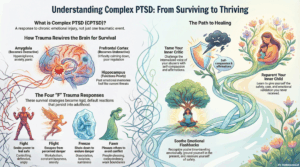
The provided text is an excerpted transcript from a YouTube video summarizing the key concepts of Pete Walker’s book, Complex PTSD: From Surviving to Thriving. The source outlines the nature of Complex Post-Traumatic Stress Disorder (CPTSD), differentiating it from traditional PTSD by explaining that it results from prolonged, repeated childhood emotional trauma within the home, rather than a single event. The summary focuses on practical aspects of healing, including how trauma affects the developing brain and nervous system, which gets stuck in survival modes like the “Four F” trauma responses (fight, flight, freeze, and fawn). Crucial steps for recovery covered include managing emotional flashbacks, challenging the inner critic by practicing reparenting, engaging in the process of grieving a lost childhood, and building both boundaries and safe relationships.
How does CPTSD differ from traditional PTSD regarding origin and manifestations?
The differences between Complex Post-Traumatic Stress Disorder (CPTSD) and traditional Post-Traumatic Stress Disorder (PTSD) are significant, particularly concerning their origins (causes) and their manifestations (symptoms).
Differences in Origin
The primary distinction in origin lies in the duration and nature of the traumatic exposure:
- Traditional PTSD Origin: Traditional PTSD usually results from a single traumatic incident, such as an assault or a car crash. When most people think of PTSD, they often picture war veterans or someone attacked or injured by an enemy fighter.
- CPTSD Origin: CPTSD is the result of repeated emotional injuries or many wounds over time, rather than one big traumatic event. The origin of CPTSD is often rooted in childhood, where the “war zone was your home”.
- CPTSD occurs when a person grows up in an unsafe emotional environment for so long that their body and mind become stuck in survival mode.
- This chronic exposure typically involves abuse, fear, criticism, or abandonment.
- The trauma is often relational, where the people attacking you were family members. This could involve being criticized, insulted, beaten, abused, or neglected.
- It frequently happens in environments where a child’s emotional needs were unmet, where love was conditional, neglect was normalized, and shame was used as a tool of control.
- Individuals with CPTSD often grew up having to “walk on eggshells,” being constantly vigilant because they never knew the mood of an unpredictable parent or sibling.
CPTSD is essentially the brain’s adaptation to prolonged emotional danger.
Differences in Manifestations
CPTSD symptoms often differ from those typically associated with regular PTSD.
Flashbacks
A key difference is the nature of the flashback experience:
- Traditional PTSD Flashbacks: Typically involve vivid sensory memories of the traumatic event, such as seeing, hearing, and smelling the past event (e.g., a war veteran).
- CPTSD Flashbacks (Emotional Flashbacks): According to Pete Walker, CPTSD involves emotional flashbacks that “sneak up, often without warning”. These are massive emotional reactions where the individual might suddenly feel small, ashamed, panicked, or hopeless, even if nothing particularly bad is currently happening. These feelings seem to come out of nowhere. Walker writes that these are triggered by present-day situations that activate unresolved childhood trauma, making old emotional memories feel like current threats. The body mistakenly believes it is back in the past; this is referred to as emotional time travel.
Distinct CPTSD Symptoms
People with CPTSD manifest several symptoms that are often unique or more pervasive than in traditional PTSD:
- Internalized Responses: Sufferers often struggle with a harsh inner critic, toxic shame, and difficulties with self-worth and trust. The inner critic is described as the internalized voice of the abusers.
- Relationship and Social Issues: Manifestations include social anxiety, abandonment issues, difficulty trusting others, self-sabotage, and avoidance of closeness.
- Maladaptive Coping Behaviors: Individuals develop reflexive survival responses carried into adulthood, such as getting stuck in people pleasing or lashing out in anger.
- The Four F Responses: The nervous system becomes stuck in a persistent fight, flight, freeze, or fawn state. These four trauma responses become survival strategies that infiltrate every area of life:
- Fight: Manifests as becoming angry, defensive, bitter, controlling, or rigidly fighting back in upsetting situations (e.g., getting defensive about feedback).
- Flight: Involves avoidance, constantly worrying and planning, or coping by staying busy (workaholism, overachieving, anxious doing).
- Freeze: Characterized by shutting down, feeling dissociated, unmotivated, isolated, numb, or withdrawing into fantasy.
- Fawn: Survival through pleasing others, becoming codependent, overly accommodating, or constantly complying to avoid being hurt.
Because these symptoms are often different from regular PTSD, they are frequently misdiagnosed as anxiety, depression, borderline personality, or even ADHD. When viewed through the lens of trauma, these behaviors are understood as protective strategies developed during an abusive or neglectful environment.
What are the core therapeutic strategies for healing the relational and psychological wounds of CPTSD?
The core therapeutic strategies for healing the relational and psychological wounds associated with Complex Post-Traumatic Stress Disorder (CPTSD) focus on rewiring the brain, regulating the nervous system, challenging internalized abuse, and cultivating healthy self-relationship and external relationships.
Pete Walker emphasizes that healing is about daily practice and consistent use of several tools, recognizing that recovery is a spiral that deepens over time, not a linear process.
I. Healing the Psychological Wounds: The Inner Critic and Toxic Shame
One of the most damaging psychological effects of complex trauma is the development of toxic shame and a harsh inner critic, which is described as the internalized voice of the abusers.
Strategies for healing this wound include:
- Building an Inner Defender: Walker teaches how to cultivate a strong, compassionate voice to protect the wounded inner child.
- Challenging the Inner Critic’s Lies: This involves an inner dialogue where you actively challenge the critic. Examples include:
- Using anger to defend yourself (e.g., “Don’t talk to me that way”).
- Talking to yourself with kindness (e.g., “I’m a worthwhile human being” or “Everyone makes mistakes”).
- Validating your own feelings (e.g., “It’s okay to feel sad sometimes”).
- Repeating affirmations (e.g., “I’m not broken. I’m in the process of healing”).
- The more the inner critic is challenged, the weaker it becomes.
II. Reparenting and Inner Child Work
Since most individuals with CPTSD were not emotionally nurtured and lacked models for love and safety, healing requires learning to give oneself what was never received, a process called reparenting.
Key reparenting strategies include:
- Self-Care and Protection: Treating yourself with the care and protection a good parent would provide, encompassing both physical and emotional needs. This might look like eating when hungry, resting when tired, setting boundaries, and creating structure and routines.
- Emotional Tending: Learning to sit with, comfort, and validate your emotions instead of numbing, ignoring, or shaming them. You imagine yourself as the gentle parent you yearned for and treat yourself that way.
- Journaling to Connect: A practical way to reparent is journaling to take care of your inner child and connect with her. This involves self-connection, such as writing, “Oh, dear little me. I see how scared and lonely you felt. I’m sorry no one protected you, but I’m here now and I won’t abandon you again”.
III. Processing Trauma and Grief
Healing requires acknowledging and moving through the pain:
- Grieving the Loss: Healing often requires grieving the loss of a safe childhood, healthy attachment, love, or protection. Grief is described as facing reality and acknowledging how much the trauma has weighed on you, allowing yourself to say, “That shouldn’t have happened. I deserved better”. Paradoxically, allowing the grief to move through you often frees you to let it go.
- Healing Emotional Flashbacks: Flashbacks in CPTSD are typically massive emotional reactions that feel like “emotional time travel”. The key to healing is:
- Recognizing and naming the episode (“This is an emotional flashback”).
- Grounding yourself (feeling your feet, breathing, and coming back to the present moment).
- Reassuring yourself (“I’m safe now. This feeling will pass”).
- Soothe the inner child.
IV. Addressing Maladaptive Survival (The Four Fs)
Individuals with CPTSD often carry reflexive survival responses (Fight, Flight, Freeze, Fawn) into adulthood. The therapeutic goal is to gain insight into these dominant patterns and develop more flexible and adaptive ways of responding.
Specific adaptive practices include:
| Dominant Response | Maladaptive Behavior (Example) | Therapeutic Practice | Source |
|---|---|---|---|
| Fight | Getting defensive about feedback. | Add the skill of listening and pausing without responding to allow time to calm down. | |
| Flight | Withdrawing when things feel threatening (e.g., conflict in marriage). | Practice staying and facing difficult encounters, such as firmly saying “no” and expressing your opinion. | |
| Freeze | Shutting down, avoiding action, or struggling to promote ideas at work. | Practice rehearsing action ahead of time or engaging in physical movement (like taking a self-defense class). | |
| Fawn | People pleasing, codependency, or inability to express needs. | Work with a therapist to develop assertive communication and practice speaking up for needs. |
V. Healing Relational Wounds and Building Connection
Since CPTSD is relational trauma, it heals best in relationship with safe, loving people.
- Setting Boundaries: A major component of recovery is learning to set and maintain boundaries. This includes:
- Recognizing that you have the right to say no.
- Prioritizing safety over obligation.
- Limiting or ending contact with toxic people.
- Learning to say no without guilt and stopping the need to justify or overexplain.
- Recognizing that biological connection does not equal emotional safety.
- Cultivating Safe Relationships: Walker recommends starting with predictable and empathetic relationships, such as a therapist. Individuals can then benefit from support groups to practice healthy vulnerability, and eventually build trusted friends to rewire their sense of trust and belonging.
VI. Regulating the Nervous System
Because prolonged survival mode can leave the nervous system dysregulated, healing must involve calming the body, not just the mind. Regulation is a skill that can be rebuilt.
Strategies for somatic healing include:
- Gentle movement.
- Vagal tone exercises.
- Deep belly breathing.
- Doing a body scan.
- Getting a massage or touch therapy.
- Spending time in nature.
These practices help the body learn that rest is safe and aid in the process of rewiring the nervous system to believe, “I am safe. I am lovable. I belong”.
Studio
Audio Overview Video Overview
Mind Map Reports
Flashcards Quiz
Infographic Slide Deck