
Science & Research
Diagnosis of the Source of Money (DSM)
Yet another captured discipline?
… the creation of a $80 billion profit centre.
SIPRI
Lockheed Martin
Boeing
BAE Systems (UK)
Raytheon
Northrop Grumman
General Dynamics
EADS (trans-Europe)
United Technologies
Finmeccanica (Italy)
Thales (France)
The Baloney Detection Kit
10 Questions:
1. How reliable is the source of the claim?
2. Does the source make similar claims?
3. Have the claims been verified by somebody else?
4. Does this fit with the way the world works?
5. Has anyone tried to disprove the claim?
6. Where does the preponderance of evidence point?
7. Is the claimant playing by the rules of science?
8. Is the claimant providing positive evidence?
9. Does the new theory account for as many phenomena as the old theory?
10. Are personal beliefs driving the claim?
Skeptic (Devaluation works both ways)
The Lost Science of Money
Bankers, Economists and Politicians much prefer “I’m above it”
A Systems Analysis Perspective
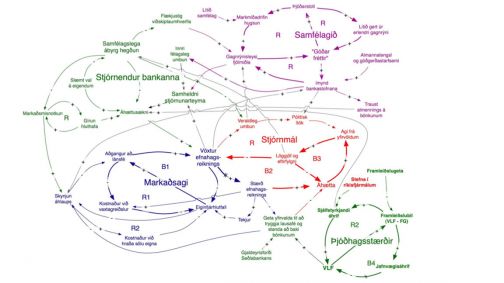 Icelandic Economic Collapse
A Systems Analysis Perspective on financial, social and world system links
“We live in a time with ever increasing complexity in society and this is reflected in our lives becoming more complex and less easy to understand. Globalization has meant that events andcausal chains span larger distances, structures are less transparent and the way the world worksis becoming more difficult to understand. The Icelandic bank crisis, the co-occurring national financial collapse and world financial crisis was part of a larger set of linked events that are difficult to overview and penetrate.”
…
“The Icelandic economic collapse was real and very serious for a small country. Only by silent intervention of its Nordic neighbours were certain basic functions of supplying the country with essentials maintained. Without this, the situation for the Icelandic population would have been noticeably bad or even dangerous”
….
“After the financial collapse of the banks and later the state, the financial transactions and transfers were mapped out in detail in a Parliamentary Special Investigative Report (2010), including who was involved and their actions described as far as possible. However, these results are all outputs from an economic system where decisions were made somewhere else in the larger societal system. To come closer to the question of how and why the economic bubble could go so far, we also need to address the social dimension of the collapse.”
…
“One issue stands out clear from the global financial crisis, and that is that the there is no way back, the old system was flawed on a fundamental level, and the international financial and policy context is still very unsustainable. The whole world´s economic system, which is based on material resource consumption forever, has reached a limit we knew would be there somewhere in time, and which will eventually stop it (Meadows et al. 1972, 1992, 2005, Latouche 2007,Jackson 2009). Growth economics on a limited planet is unrealistic.”
…
Icelandic Economic Collapse
A Systems Analysis Perspective on financial,
social and world system links (.pdf)
—
System dynamics
Causal loop diagram
“Anyone who believes that exponential growth can go on for ever in a finite
world is either a madman or an economist” ~ Kenneth Boulding
Al Bartlett: In Growth We Trust (the simple math 1 to 8 ) and
The Essential Exponential!
—
Related ?
The Four Horsemen
“The prostitution of the economics profession” [1].[2]
“not much to do with what the Constitution calls for.” [1].[2]
In the Valley of Elah
No Such Thing as a Random Sample

 Opinion Makers are preparing a “National Assembly” (whole 0.3%) to flash out ideas of how we should mark our future after the horrific failure in our past.
At first look this appears to be a grand idea, Democracy at Work, – finally.
The selection process has been trumpeted as random sample out of the National Registry, i.e “having no definite aim or purpose; not sent or guided in a particular direction; made, done, occurring, etc., without method or conscious choice; haphazard”.
To start off, large sections of people have opted out of being included in ‘samples’ of any kind and the rest just don’t bother or have no knowledge of the possibility. People of foreign nationality although legible to vote in local elections automatically drop out, a primitive ‘random’ record collector is used, and there are many more limitations on the ‘randomness’.
Then there is the simple question of the organizers, who are they (Chamber of Commerce?), and the question who decided on those, who are the specially preselected representatives of special interests, and who decided on the general framework of the meting (consumer panels)?
So we are back to the “Propaganda model”, Agenda Setting by Predetermine, Select, Shape, Control and Restrict by: Selection of Topics, Distribution of Concerns, Emphasis, Framing of Issues, Filtering of Information and Bounding of Debate